Listen to an audio description of Eleanor Vere Boyle’s 1875 illustration for Beauty and the Beast.
This book illustration was made by Scottish artist Eleanor Vere Boyle in around 1875. It’s on a squarish rectangular piece of paper in portrait orientation. It’s quite small - about the same size as a page from a paperback book - but it’s rich in detail. The whole surface of the paper is painted, mostly in watercolour in muted naturalistic greens and browns, with some areas of opaque bright white gouache.
Across the bottom third of the illustration is a pale pinkish brown stone wall. A bluish-green prickly pear cactus is growing in front of its right side. The cactus has rounded pads covered in short and hard-looking spikes. Its lower pads are catching the light, and on one the word ‘Beauty’ is scratched into its surface.
Behind the wall is a person, positioned in the centre of the left side of the illustration. Their body is facing us, but their head is turned to face the top-right corner. Behind them are large grey-green leaves of aloe vera that are unfurling in all directions. The leaves have spiky edges. They aren’t touching the person, but if the person moved, they might get scratched. The leaf to the top left of the person has the word ‘Beauty’ scratched into its surface.
The person is wearing a Tudor-style dark blue hat with a crimson red feather decoration on top. Around their shoulders is a white arm-length cape. The cape is painted in white gouache, and is brighter than the dark foliage surrounding it. It is fastened at the front with a gold clasp, painted with finely-ground gold powder. Along the bottom edge of the cape are two horizontal blue stripes. Underneath the cape, the person is wearing a dark blue tunic. Their hands are raised as though in alarm. Their left palm is open and resting on the top of the wall. Five white roses painted in the same bright white gouache as the cape are falling from their hand, as though they have been dropped in shock. Their right arm is raised so that their open hand is at shoulder-height with the cape draped around the wrist.To the right of their hand is an aloe vera leaf, the only one in the image that is brown and withered.
The person’s head is in profile, facing right. They have fair pale-brown skin, dark brown shoulder-length curly hair, and a full beard and moustache. Their eye is open wide, looking up towards the top-right corner of the image. Meeting their gaze is creature emerging from the gloom, behind an aloe vera leaf. The creature’s head is around twice the size of the person’s head and rounded, like a seal’s. Its mouth is wide open, with two long white tusks running down from its upper jaw. The creature has a pink cat-like nose and large dark eyes that seem mournful, rather than fierce.
Eleanor Vere Boyle’s own caption for her illustration reads; “Upon the strange prickly leaves, someone had curiously carved Beauty's name… The Beast came near, and the roses fell from his grasp.”
This is one of a series of ten full colour illustrations that Boyle created for her retelling of French fairy tale La Belle et la Bête, Beauty and the Beast, a story in which a woman is imprisoned by a monster and then falls in love with them. Boyle’s Beast is different from any version of the character created before or since: instead of being an upright figure with human features and clothes, Boyle’s Beast is a walrus-like sea creature. Her version of the story was published in 1875.
Boyle was a wealthy woman from a landowning family. She was expected to focus on her home and family, and not to have a career of any kind. However, she illustrated 21 books in her lifetime, including Beauty and the Beast. She usually remained anonymous, signing many of her illustrations only with her initials, ‘EVB’.
More audio described illustration
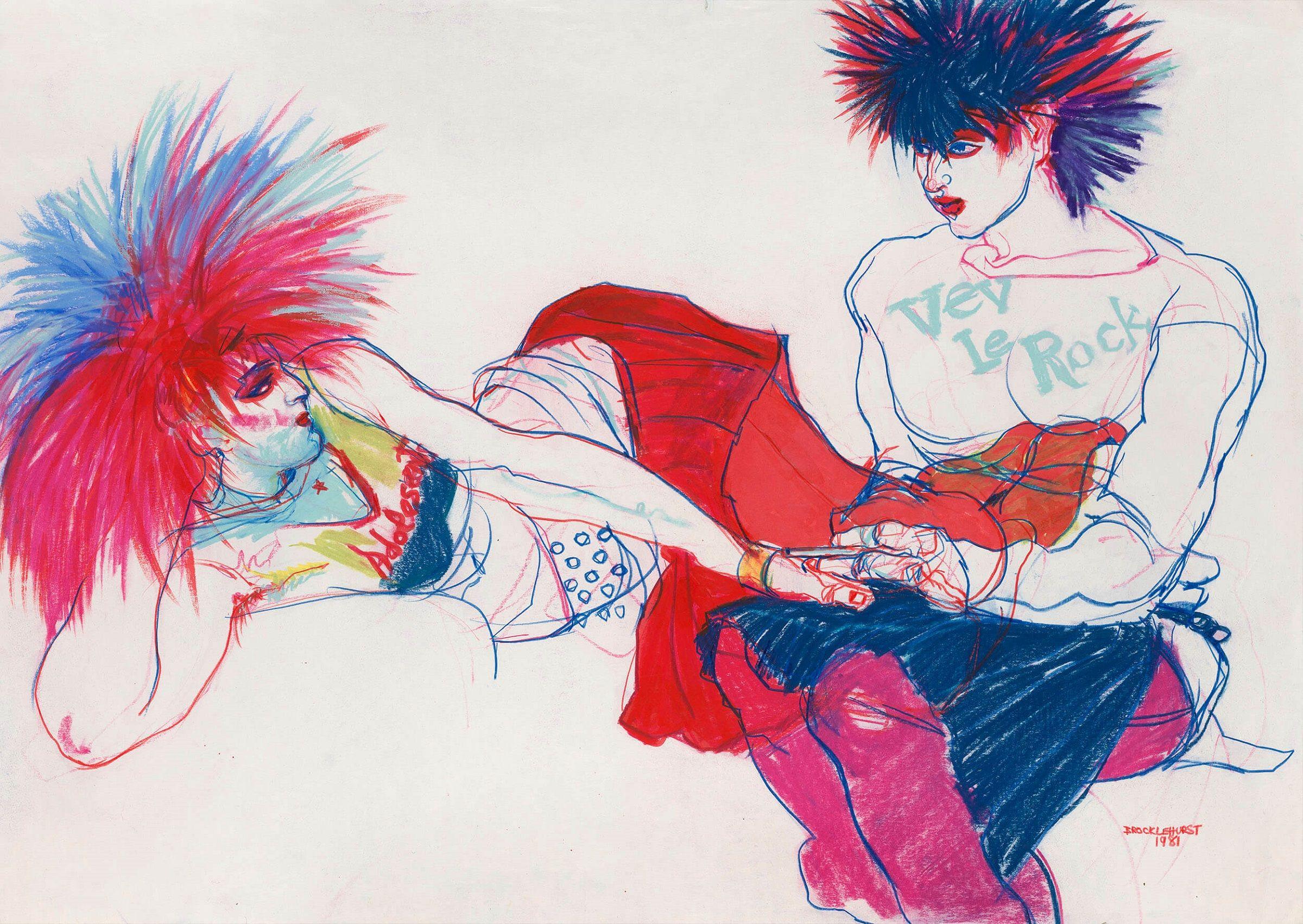
Drawing by Jo Brocklehurst, 1981