Listen to an audio description of Daysi García López’s 1969 poster, Day of Solidarity with the Afro-American People.
This poster was designed by Daysi García López in Havana, Cuba in 1969. It’s a bold design, made up of areas of flat block colour. Lopez designed it this way so it could be printed using different techniques; either by screenprinting or by offset lithography. This version was printed by offset lithography. The printed ink is matt and sits flat on the surface of the paper. It feels completely smooth, apart from a horizontal fold running through the centre.
The poster is a narrow rectangle in portrait orientation, about as long as two A4 pieces of paper. Around the edge is a thin mid-blue border that creates a frame for the design. Inside the frame is an area of unprinted off-white paper, with the design elements printed on top. At the top edge there are four lines text. The bottom half is filled by a silhouette of a person’s head facing to the left.
The text at the top is printed in small letters in the same mid-blue as the border. There are four lines, each running nearly the full width of the paper. Each line is written in a different language. From the top, these are: Spanish, English, French and Arabic. In English, the line reads “Day of Solidarity with the Afro-American People / August 18”. To the right of the text is a logo in the same blue: it has an image of a globe, balanced on a fist gripping a rifle, and the word ‘OSPAAAL’ underneath in capital letters.
The silhouette of the person’s head is printed in black ink and fills most of the bottom half of the poster. They are looking out to the left. The only detail is the white of their eye, which is printed in dark green. It’s hard to tell their expression, but they are looking directly in front of them and seem focused. The outline of their hair is wavy.
Inside the silhouette where the person’s hair would be is an image of a tree. It runs up from the back of their head round to their forehead. The trunk is baby pink and spiky - like a palm tree trunk - and at the top are four fan-shaped leaves in a darker pink. Underneath the tree are three people, positioned between where the silhouetted person’s ear would be and their neck. The three people all facing to the left, the same direction as the silhouette. Their skin is dark green and they are wearing patterned clothes. A person standing at the back of the group is wearing a one-shoulder floor-length mid-blue robe with a diagonal pattern made of light blue lines, pink triangles and purple squares. Their front leg is straight and their back leg is bent, making their robe into a graphic triangle shape. They are holding a up a bright orange bow and drawing back a pink arrow which is pointing to the left. In front of them, another person is crouching down with a small child holding onto their back. They are wearing a headwrap and dress in light pink with purple and red patterned stripes. They have a pink bangle on their left wrist and a blue circle-shaped earring. They are holding a bright orange rifle with a pink strap, pointed to the left. The child on their back is wearing a bodysuit with checked mid-blue and purple squares.
Daysi García López designed this poster for the Organization of Solidarity with the People of Africa, Asia and Latin America, known as OSPAAAL. Founded in 1966, OSPAAAL was a non-governmental organisation based in Havana, Cuba. It aimed to promote cooperation between countries and liberation movements across the Global South, as well as the Black Power movement in the USA. The organisation produced Tricontinental magazine, a digest of revolutionary news and radical political writing that was distributed al over the world. Inside each issue was a folded poster promoting solidarity with a different revolutionary cause. More than 50 designers, including Lopez, worked on OSPAAAL’s magazines and posters between the 1960s and 1990s. Lopez’s poster was produced at a time when copies were being printed and distributed in editions of up to 50,000. This copy has slight damage to its corners and so may have been displayed, but we don’t know where.
More audio described illustration
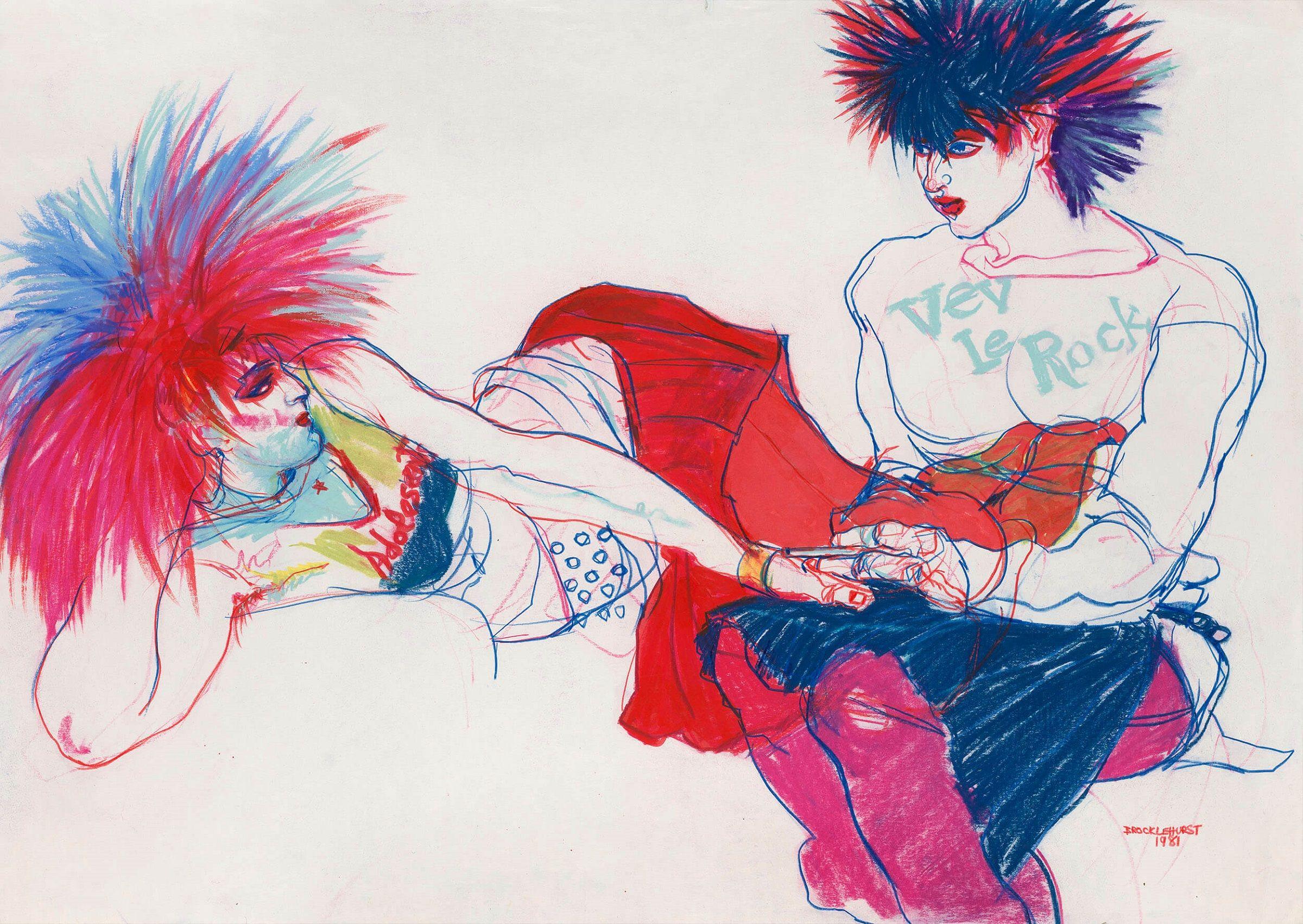
Drawing by Jo Brocklehurst, 1981